Off the western tip of Cuba, deep in the Yucatán Channel, a sonar survey found shapes too
regular to ignore — pyramids, blocks, what looked like roads. For 25 years the internet has
called it Atlantis. This is the long version: exactly what was found, what was merely claimed, the
images that exist, and the one physical fact the romantic story can't get past.
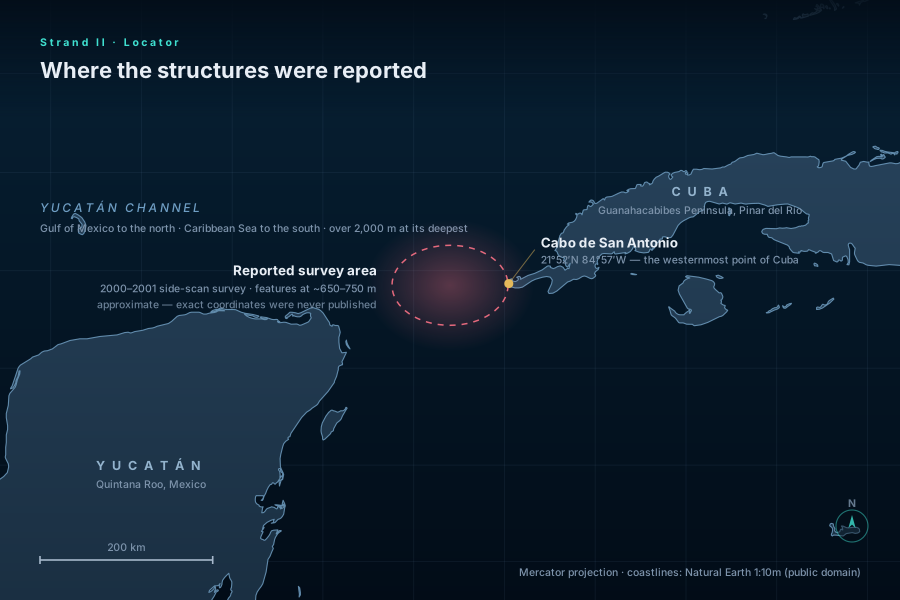
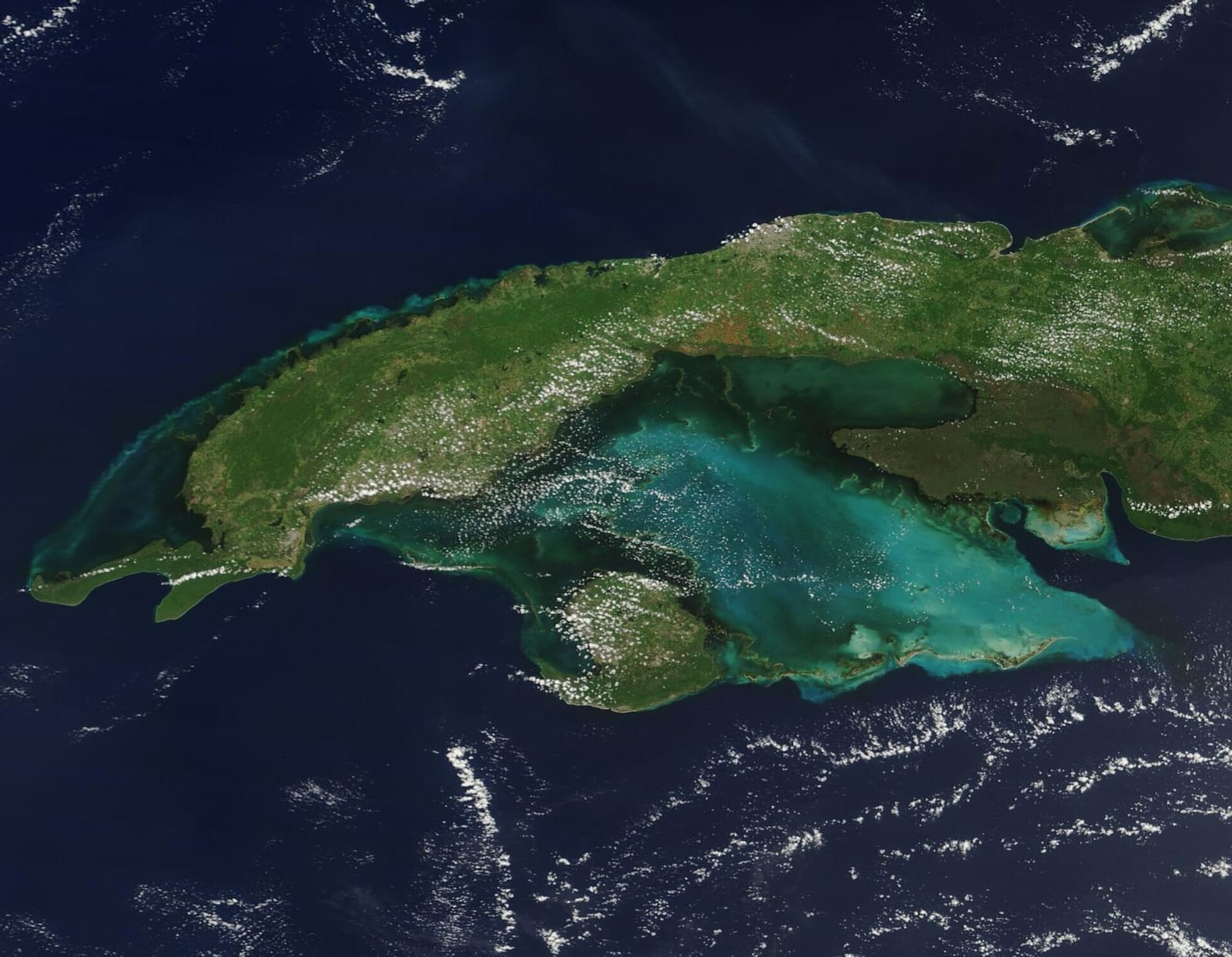
Where the structures were reported: offshore from the Guanahacabibes Peninsula, in the Yucatán Channel, at roughly 650–700 m depth.Coastlines are projected from Natural Earth 1:10m vector data, so the geography is real rather than sketched. The survey zone is drawn as an area, not a pin, because the team never published coordinates.
Strip away the headlines and the chronology is short, and revealing — a genuine anomaly, a media surge, one cautious scientific visit, then silence.
1966
A land megalith is dated to ~4000 BC
A megalithic structure excavated on land in western Cuba is reported to date from around 4000 BC. Decades later this single land find becomes the entire basis for the “~6,000-year-old” figure attached to the offshore features.
1998–2000
ADC surveys Cuban waters
Advanced Digital Communications (ADC) — a Canadian-Cuban venture led by Paulina Zelitsky (Zalitzki) with Paul Weinzweig — works under contract with the Cuban government, using side-scan sonar to survey for shipwrecks off the western coast.
July 2000
The sonar anomaly is recorded
The survey detects large, symmetrical, geometric features on the seabed off the Guanahacabibes Peninsula at roughly 650–700 metres depth — far deeper than any expected wreck.
May 2001
The story goes global
Reuters and the BBC report the find. The framing — a possible submerged “city” with pyramids and roads — spreads worldwide and the Atlantis comparisons begin almost immediately.
July 2001
A return with an ROV — and a cautious geologist
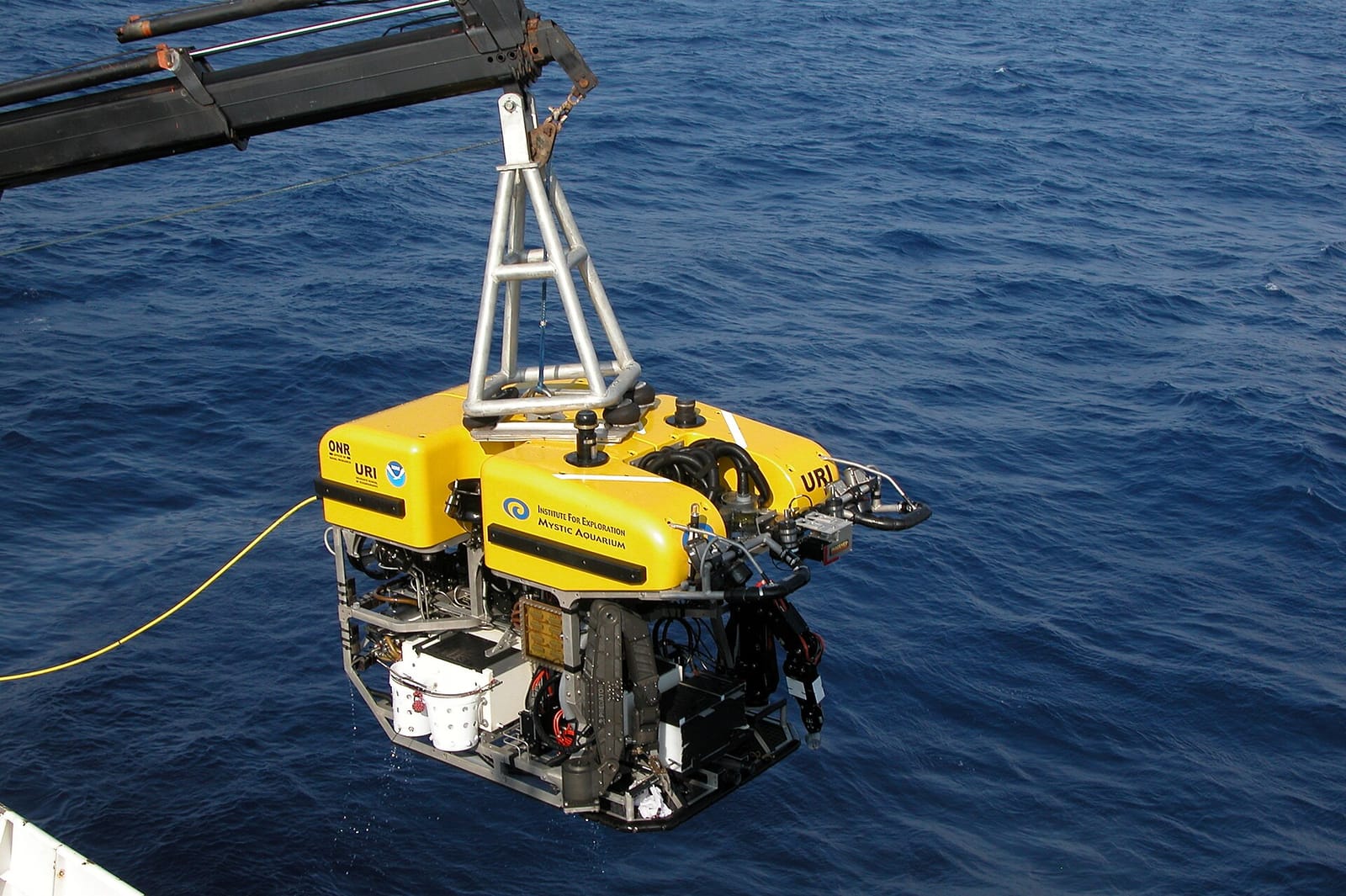
The team returns with a remotely operated vehicle and Cuban geologist Manuel Iturralde-Vinent. He calls the features “extremely peculiar” but stresses they cannot yet say whether they are man-made or natural — and that nature can create strikingly regular forms.
2001–2002
National Geographic interest, then quiet
National Geographic reportedly documents the site, lending media credibility. But no peer-reviewed study follows; a reported April 2002 ROV dive recovers only a small encrusted stone that proves nothing either way.
2002 → today
The trail goes cold
For more than two decades there is no rigorous follow-up. The claim survives almost entirely on the original 2001 reporting, recycled endlessly by ancient-mysteries outlets — and nothing since 2002 has produced close-up imagery or samples that could settle the question.
The discovery is real and well-documented: a Canadian-Cuban company, side-scan sonar, symmetrical
features at roughly 650–700 metres. What happened next is where care matters. The team's vivid
description — pyramids "like the Maya," cut granite blocks, a city "older than the pyramids" — is a
characterisation, not a confirmed finding. The discoverers themselves hedged.
Proven
A 2000–2001 ADC sonar survey found symmetrical features off western Cuba
In July 2000 a team from Advanced Digital Communications — Paulina Zelitsky (Zalitzki), Paul Weinzweig, and Ernesto Tapanes — working under contract with the Cuban government, detected large symmetrical/geometric features via side-scan sonar off the Guanahacabibes Peninsula. Reported publicly in 2001.
Verified 3-0. Discovery and public report are distinct events.
The find was a by-product of a routine survey aboard the research vessel Ulises
Paulina Zelitsky — a Soviet-born ocean engineer and president of ADC, working from an office at Tarara east of Havana — was conducting deep-sea surveys (reported as ocean-temperature and shipwreck work) aboard the Cuban research vessel Ulises in summer 2000 when the sonar returned the anomalous features. The discovery was incidental, not the goal of a treasure hunt.
This depth figure is well-documented in the 2001 reporting — and it is precisely what creates the decisive scientific objection to a human-made origin.
Weinzweig described pyramids resembling Mayan/Aztec temples, megaliths “like Stonehenge or Easter Island,” roads, and “granite-like blocks, between 2 and 5 metres in length, cut in perpendicular and circular designs.” This documents the team’s characterisation — NOT that the structures are artificial. The originals hedge with “may be.”
Verified 3-0/2-1 as a description of the claim, not of reality.
The "~6,000 years old" age was conceded as speculation by the discoverer
Weinzweig on record: “we’re speculating that these are 6,000 years old … It’s not exact.” The inference rests on a 1966 land excavation of a nearby megalith “said to date from 4000 BC.” Never present this as a finding.
Verified 3-0. Self-described as unscientific speculation.
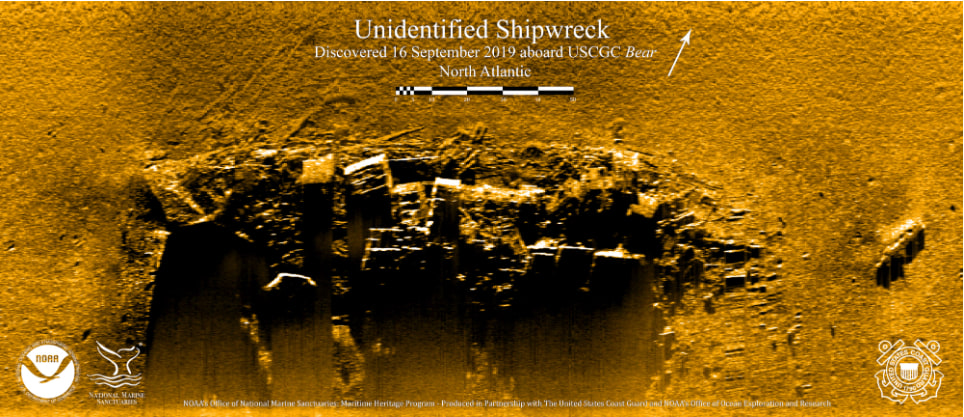
Almost every retelling shows the same handful of grainy sonar returns. They are genuinely intriguing —
and genuinely low-resolution. The famous scans are owned by the discovery team and National Geographic,
so we link them at their source rather than re-hosting them. What matters is the gap between the
acoustic data and the city reconstruction drawn on top of it.
The original sonar/seabed imagery from the ADC survey (rights held by the discoverers / National Geographic). Viewable via contemporaneous coverage — we do not re-host copyrighted scans.Advanced Digital Communications / National Geographic
Going past the recycled headlines into the geologist's own paper and the contemporaneous record changes
the picture in one important way: the most damning number — the ~50,000-year submergence — is not a
skeptic's invention. It is Manuel Iturralde-Vinent's own calculation. The man the
discoverers brought in to lend authority is the same man whose math rules out a human city.
Proven
The geologist’s own paper names the site "MEGA": ~600–750 m deep, ~20 km²
In a scientific paper, Cuban Museum of Natural History geologist Manuel Iturralde-Vinent designated the megalithic area "MEGA," recording a present depth of 600–750 m and an extent (per ADC) of roughly 20 km² (~8 sq mi). This is the most technical first-hand description on record — and it is the geologist’s, not the promoters’.
From Iturralde-Vinent’s institutional paper (cuba.cu, now offline; quoted verbatim via PhysicsForums archive).
Iturralde-Vinent’s own calculation: the site would have had to sink ~50,000 years ago
This is the decisive number, and it comes from the geologist himself — not a blog. From the present depth (600–750 m) and the maximum Ice-Age sea-level fall, Iturralde-Vinent calculated that if the area was ever above water it must have submerged "more than 50,000 years ago" — and noted that "50,000 years ago there wasn’t the architectural capacity in any of the cultures we know of to build complex buildings."
Now attributable to Iturralde-Vinent’s paper and corroborated across multiple outlets — upgraded from the earlier blog-only status.
Iturralde-Vinent weighed two hypotheses — and favoured neither comfortably
His paper laid out competing explanations: (1) interesting natural structures (he cited analogues like the "Altar of the Virgin" formation in Guanahacabibes), which the recorded data did not fully support; and (2) man-made structures, which the 50,000-year timeline makes archaeologically impossible. His 2002 evaluation of multibeam data emphasized random alignments consistent with tectonic disruption and mass-wasting — i.e. leaning natural.
Reported from his paper; he explicitly declined to declare the features man-made.
A 2002 ROV expedition recovered a stone sample — with an inconclusive result
On the April 2002 "Exploramar" expedition, an ROV recovered a roughly 12 cm stone from the sandy seabed at the megaliths. A marine-invertebrate specialist at the University of Havana identified a barnacle on it — a biological encrustation that speaks to time underwater, not to artificial origin. No analysis has ever demonstrated the blocks were quarried or worked by humans.
Reported from Iturralde-Vinent’s account; physical sampling occurred but proved nothing artificial.
The geologist who actually went back with an ROV, Manuel Iturralde-Vinent, never declared it
man-made — he said the opposite of certainty. And no peer-reviewed study or confirmed deep-submersible
return has followed in over two decades. Meanwhile, one fact governs everything below.
Proven
Geologist Iturralde-Vinent was cautious, not confirmatory
In July 2001 the team returned with Cuban geologist Manuel Iturralde-Vinent and an ROV. His actual position: “until we can physically examine these structures, we can’t say for sure whether they’re manmade or natural. Nature is able to create some really unimaginable structures.” National Geographic documented the site but provided no peer review.
Quotes corroborated across multiple outlets; treat as reported.
National Geographic looked — and stayed carefully non-committal
NatGeo figures including senior editor John Echave (and, per some accounts, Robert Ballard) viewed the sonar images; NatGeo News covered it (Brian Handwerk, 28 May 2002). Echave’s on-record verdict: "They are interesting anomalies, but that’s as much as anyone can say right now… until we are able to actually go down there and see, it will be difficult to characterize them." No NatGeo expedition confirmation followed.
The actual NatGeo stance was caution, not endorsement.
No peer-reviewed publication, and nothing settled since the 2001–2002 ROV dives
The public story rests on 2001 wire reporting quoting the team, plus the geologist’s own accounts. There has been no peer-reviewed paper, and since the July 2001 ROV return (and a reported 2002 sampling dive) no expedition has published close-up imagery or samples that settle the question.
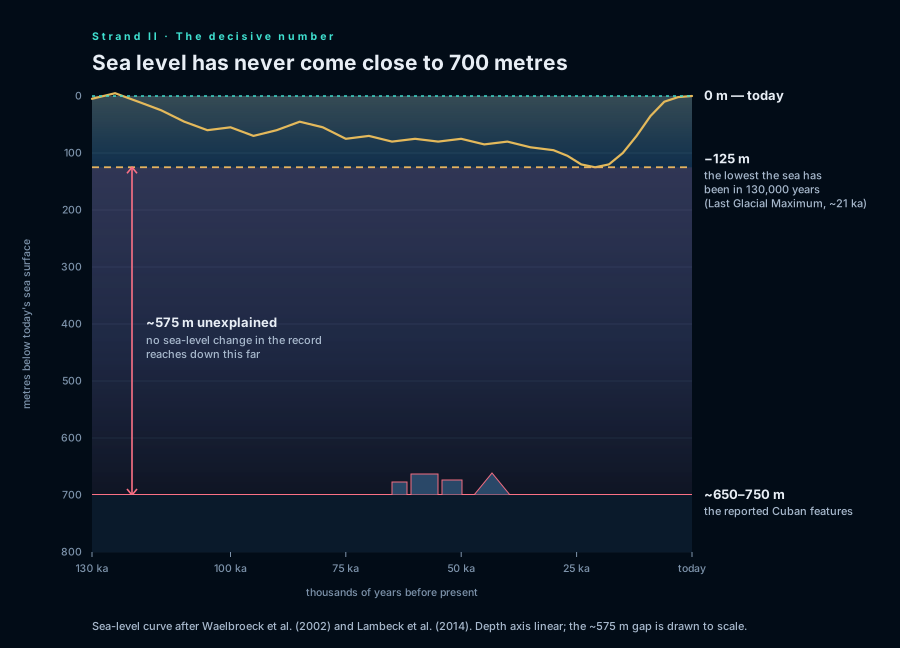
The decisive objection: nothing sinks a coastal city to 700 m within human history
Ice-Age sea level fell only ~120–130 m at maximum; reaching 700 m would require tectonic subsidence over hundreds of thousands to millions of years — long before humans. Leading mainstream explanation: natural formation (limestone fracturing, collapsed karst). NOTE: specific figures circulated online trace only to blogs and were unverified; the ~50,000-year estimate is now sourced to Iturralde-Vinent’s own paper (see the MEGA claims). The argument is directionally sound and is the consensus, but the portal states it in its own voice.
Blog-sourced specifics abstained 0-0 (unverified, not disproven).
Zelitsky variously likened the complex to the "pre-classic" / Teotihuacan-like cultures (~2,000 years old). But the depth requires submergence tens of thousands of years ago — long before Teotihuacan or any Mesoamerican monumental building. The "advanced ancient culture" reading is internally inconsistent with the very depth that makes it sensational.
A logical contradiction visible within the discoverers’ own statements.
The depth problem, plotted rather than asserted. Across the whole last glacial cycle the sea never dropped more than about 125 m below today. The features sit near 700 m.That ~575 m gap is the entire argument, and it is a measured distance on this chart. Closing it needs tectonic subsidence over hundreds of thousands of years — a timescale with no city-builders anywhere in it.atlantisite.com — plotted from Waelbroeck et al. (2002) and Lambeck et al. (2014)
The leap from "unusual sonar returns" to "Atlantis / Cayce / the Maya" was made by media and
ancient-mysteries sites, not by evidence. It's worth understanding as cultural reception — how
a genuinely intriguing anomaly gets absorbed into a pre-existing myth — rather than as a finding about
the seabed.
Unproven Theory
The Cuba features as Atlantis, a Cayce prophecy or a Maya “lost land”
Connections drawn between the Cuba features and Atlantis, Edgar Cayce’s Bimini predictions, or a Mayan “lost land” are popular on ancient-aliens sites and have no documented evidentiary basis. Document them as cultural reception, not findings.
No reliable evidence links the sonar features to any of these.